February has been a month of ups and downs here at Glueplant Games. After releasing our first playable demo of Steps last month, we dove straight into preparing our next funding application, all while battling a lot of sickness.
Despite some setbacks, the month has still brought important progress. New systems have started making their way into the game, updates are underway, and we’ve welcomed a new partner to the journey.
Let’s take a look at what’s been happening.
Strengthening Our Next Application
Following the launch of the demo, the first half of February was largely dedicated to preparing our next funding application.
After receiving feedback from both NFI and Østnorsk Filmsenter, we realized that our existing documentation needed great improvement. In particular, we were advised to develop a more detailed market and target audience analysis. The document should not just state who our audience is, but go in-depth on who our target audience is, why we design the game the way we do and how we plan to reach that audience.
We spent several days meeting at the local library, talking about the future, revisiting earlier decisions, and building this new document from the ground up.
During this process, we also reshaped the story of Steps. Originally, we planned for the game to have two possible endings, where the player could either settle down or continue wandering forever. The character Stepellier was meant to represent the latter path, encouraging the player to keep moving and never settle.
But as the story evolved, we realized something important: the message of the game becomes stronger if the journey has a clear destination. The player’s journey will now conclude by settling down in one of the regions of the world. This approach allows the deeper theme of the game, the journey as an analogy for human life, to become much clearer and more meaningful.
As part of this change, Stepellier also becomes a more defined antagonist: a character who believes in living forever and refuses to see the value in the journey that life itself represents.
Something we’ve found quite interesting over the past year is that every new application phase seems to reveal additional documents we didn’t realize were required when we first started the project. These little “surprises” have made each pre-application period feel like two very intense weeks of work, tasks that, in hindsight, ideally should have been completed during pre-production.
Now that we’ve spent a year inside the industry, we’re beginning to understand the bigger picture much more clearly. What we once considered well-prepared documents during our early pre-production phase now appear far less complete than we originally thought.
Looking ahead to future projects, there are already many things we would approach differently. We now know there are several documents and analyses we would prepare from the very beginning, both to strengthen future applications and to avoid these mid-production document crunch periods.
Working deeply with market research has also been fascinating. Some of our original assumptions about our target audience turned out to be solid and well supported. Others, however, didn’t hold up under closer inspection. This has forced us to rethink parts of our strategy, which ultimately is very healthy for us as we continue developing Steps.
In the end, this deep dive into the market has given us a much clearer understanding of where Steps fits and how we should approach its development moving forward. Now we just have to see whether our improved documentation will be enough to secure another round of funding.
To be honest, this round feels more uncertain than the previous ones. The first funding felt like a miracle to receive. The second felt more manageable. This time, however, it feels a bit like we’re back at the beginning again.
We know that more companies in the Inland region of Norway are applying in this round than usual, meaning the competition will be stronger. On top of that, many projects are now requesting larger amounts of funding after Østnorsk Filmsenter expanded its funding structure.
Our strategy has therefore been to stay consistent, applying for the same 200,000 NOK as before and presenting a realistic production plan similar to previous phases. Our hope is that by staying modest and focused, we might quietly “slide a little under the radar” among the larger applications.
Time will tell.
A lot of sickness
At the same time as we were preparing our application and starting the new development period, February also became our most illness-filled month so far.
Unfortunately, when you're a two-person studio, there are no substitutes to call in. Lost time simply has to be made up somewhere else.
Because of the number of sick days, we’ve fallen slightly behind schedule. Moments like these are exactly why we try to build breathing room into our production plans — to allow both the team and the project to recover when things don’t go as expected.
Despite the setbacks, we’ve still made solid progress on several aspects of Steps.
One of the biggest improvements has been a new integrated text system for all menus, messages, and descriptions in the game. The system now connects directly with Google Sheets, allowing us to update text easily, including support for multiple languages.
This means no more situations where English text suddenly appears within a Norwegian language setting.
We’ve also implemented a new player data system that gathers anonymous gameplay statistics from the demo. The system tracks information such as:
- Time spent in each level
- Number of steps taken
- Number of respawns
- Time taken before collecting pickups
- And more…
This data helps us identify where players struggle, where levels might be too easy or too difficult, and how the overall player experience can be improved. Over time, it will also give us a clearer picture of how long a typical playthrough lasts.
Improving the Feel of the Game
With the new development phase underway, one of our main focuses is now the visual and auditory feel of Steps.
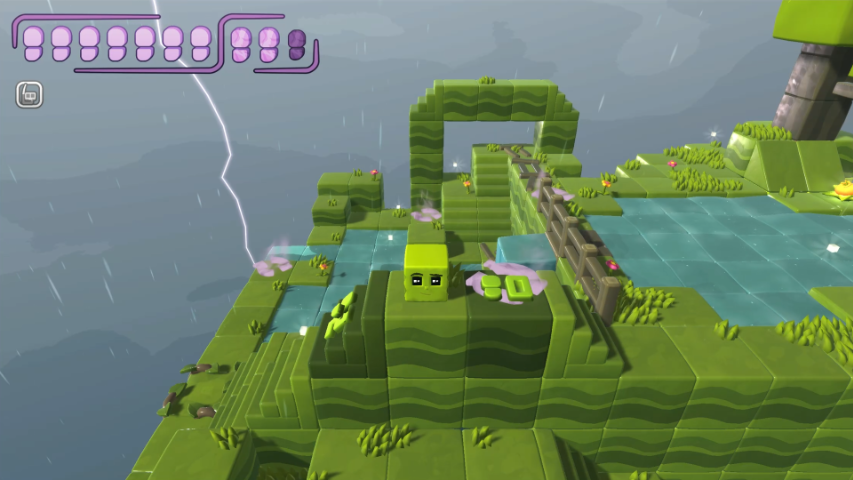
We’ve started experimenting with lighting and weather systems that will give the game world more atmosphere and depth.
Another area we want to improve is the camera behavior. At the moment, camera rotation and zoom can sometimes cause clipping through blocks and scenery, which makes the experience feel less smooth than we’d like.
To address this, we’ve started developing a shader system that creates a small “hole” between the player and the camera whenever obstacles get in the way. This is a continuation of our previous “hole” shader, and even though it’s still early in development, we can already see how much smoother the gameplay flow could become once the system is fully implemented.
A New Creative Partner
We also have some exciting news on the audio side of the project.
We’ve officially started collaborating with a sound designer for Steps! Her name is Lisette Amago.
Since Steps is built around environmental exploration and atmosphere, sound plays a huge role in shaping the experience. Up until now, we’ve been relying on open-source audio assets while testing systems. But with a dedicated sound designer joining the project, we’ll finally be able to create sounds that are designed specifically for the world of Steps.
We’re incredibly excited about this collaboration and believe it will help bring the game to life in a whole new way.
Looking Ahead
As we continue in March, we’re hoping to settle back into a steady development rhythm.
Our next goals include reaching out to gaming press outlets and summer events, hoping to start spreading the word about Steps. At the same time, the first visible improvements to the game's lighting and visual atmosphere should begin to appear.
Even though February felt slower in terms of visible progress due to sickness and application, we’re feeling hopeful and energized about the months ahead.
Sometimes the quiet months are the ones where the strongest roots grow.
Seed you next month!